
7 Types of SEO And Why Ignoring Even One Can Hurt Your Rankings
Let me be straight with you. When I first started learning SEO, I thought it was just about putting the right keywords on a page and waiting for Google to notice. That was a mistake. A pretty embarrassing one, honestly. Because SEO is not one thing. It never was. There are actually seven distinct types of SEO, and each one does something completely different for your website. Miss even one of them and you will always be stuck wondering why your traffic is not growing.
So let us go through all seven. No fluff, no unnecessary filler. Just what you actually need to know.
The 7 Types of SEO — Broken Down Simply
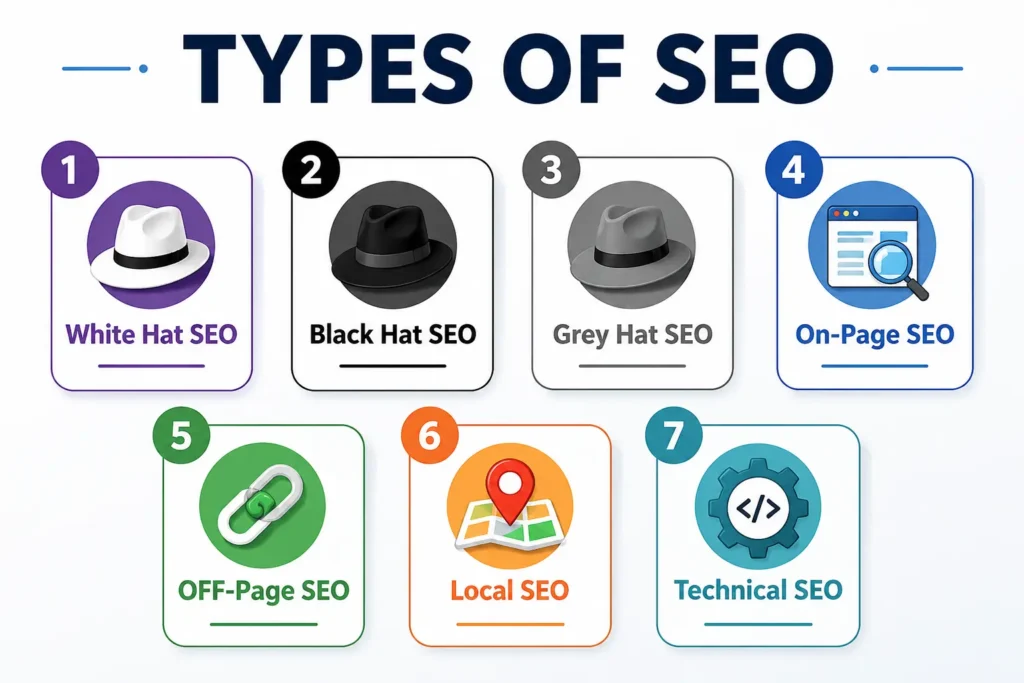
- White Hat SEO
This is where the magic happens. White Hat SEO is all about playing the game the right way – making sure you have content that will truly benefit users, getting links that you truly deserve to get and making sure that your site is something that the users would love to use. Google absolutely adores White Hat SEO since it is exactly what they want to achieve.
It does take much longer to see any tangible results. Results from White Hat SEO appear after many months and not just days. Here comes the best part – there is no expiration date on this one. - Black Hat SEO
Black Hat SEO is what happens when someone gets impatient and starts cutting corners. Stuffing keywords into a page until it reads like a robot wrote it. Buying five hundred backlinks from random websites. Hiding text on a page by making it white on a white background. Showing Google one thing and showing real visitors something else entirely.
Does it work? Sometimes, for a little while. Then Google catches up — and it always does — and the website either disappears from search results completely or drops so badly it might as well have. No legitimate business should be touching this. - Grey Hat SEO
Grey Hat SEO is harder to explain because it sits in a genuinely uncomfortable middle ground. These are tactics that are not technically against Google’s rules right now but feel a bit off. Redirecting an old expired domain with good backlinks to your new site. Swapping links with a partner website. Publishing content at a pace that prioritizes quantity over quality.
Some marketers swear by Grey Hat tactics. Some have paid the price when Google updated its algorithm and suddenly what was grey became very clearly black. It is a gamble. A calculated one, maybe, but still a gamble. - On-Page SEO
On-Page SEO is the kind that people typically begin their SEO journey with and there is a good explanation for this fact. The entire On-Page SEO process is totally under your control. Every single page of your site gives you an opportunity to either give Google information that will allow it to understand the topic of your page or just mess it up completely.
On-Page SEO is making sure that you use specific and relevant title tags. On-Page SEO is making sure that you use your focus keyword in a natural manner. On-Page SEO is organizing your content correctly and making use of headings to make it more readable for people and search engines alike. Alt texts on images, neat URLs, and logical internal links – it is all On-Page SEO. Small elements by themselves, yet together they explain everything to Google about your page and its relevancy. - Off-Page SEO
If On-Page SEO is your reputation on paper, Off-Page SEO is your reputation in the real world. It is everything that happens outside your own website that still influences how Google sees you. Backlinks are the biggest part of this — when a respected website in your industry links to your content, it is essentially vouching for you. Google treats that as a trust signal.
But Off-Page SEO is more than backlinks. It is your brand being mentioned in articles even without a link. It is customer reviews on Google and other platforms. It is guest posts you write for other blogs. It is the overall footprint your brand leaves across the internet. The more credible that footprint looks, the more Google trusts your site. - Local SEO
Local SEO is specifically for businesses that serve people in a particular area. A bakery in Kochi. A dentist in Trivandrum. A plumber covering three districts. If your customers are local, your SEO needs to be local too.
For instance,For instance, when an individual searches “best salon near me” using Google, the results that are displayed on Google are not generated based on content alone. Google examines your Google My Business Profile, your consistency in regards to your address and phone number online, the quantity of your authentic reviews, and the time when there was interaction with your profile. Local SEO is the quickest type of SEO to generate results since the competition involved is less compared to the national websites. This is very important for local business. - Technical SEO
Technical SEO is the one that gets ignored the most and causes the most invisible damage. It is everything happening in the background of your website — the stuff users never see but that search engines examine very carefully before deciding whether your pages are worth ranking at all.
Page speed matters here. A website that loads in four seconds on mobile loses customers even before they can read anything. It is important for your website to be mobile compatible, since Google now favors the mobile website rather than the desktop one. Sitemap will enable Google to see your pages. HTTPS makes your website safe. Structured data enables Google to scrape data from your pages and display stars, FAQs and other information directly on search results. Your Technical SEO must be right, or it won’t matter how good your content is, since Google won’t even be able to understand it.These 7 Types Work Together — Not Separately
Here is the mistake a lot of people make. They pick one type of SEO and treat it like the solution to everything. They spend months only on content and wonder why rankings are not moving. Or they chase backlinks while their page speed is terrible and their on-page SEO is a mess.
The truth is these seven types are not independent options you pick from. They are parts of one system. Technical SEO ensures that Google crawls your website. On-page SEO ensures that each page speaks clearly. Off-page SEO builds up the trust which helps you rise above your competition. White hat SEO ensures that there will be no penalty on your website. Local SEO ensures that you connect to local customers. While, by keeping away from black hat SEO, ensures that all your hard work doesn’t fall flat on updating of Google.
by faju

Final Thoughts on the Types of SEO
By now, you are aware of all 7 types of SEO and their functions. The reality is that none of them will work effectively by itself. White Hat SEO will keep you from doing anything that Google doesn’t like, while On-Page SEO will make sure that your content is readable. Off-Page SEO builds up your authority, and Local SEO allows you to connect with the people nearby. Finally, Technical SEO ensures that Google understands everything.